

Description
Understanding and Using the Flame Trimmer
The information below may be of interest to you.
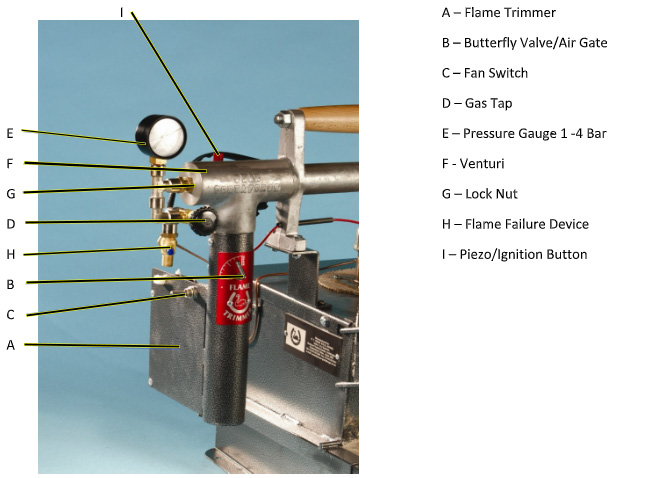
The Flame Trimmer is a low-energy fan (A), with an adjustable air gate (B) to form and balance the flame, 1970⁰C being the maximum temperature achievable. (Products of Combustion (POC’s) just evident).
FACT: Regardless of the flame size, the flame temperature remains the same.
The only difference is energy consumed and a reduction in heat-up time.
A large flame with the wrong mix = a temperature drop.
The Flame Trimmer comes with a mains adaptor for workshop use and a connecting cable for 12V systems in vehicles.
Understand Flame to Save Gas
The three types of flame are achieved by mixing different ratios of air and gas. Gas controls the flame size, while air controls the flame type and temperature.
To identify flame types, pay attention to: flame and lining colour, noise, and products of combustion (POC’s), which consist of escaping flame, unburnt gas, wasted heat, and carbon monoxide!
Flame Types
Reducing Flame (RF – Rich Flame)

10% Gas : 90% Air
Green flame, very quiet, large amounts of POC’s.
DANGER: Carbon Monoxide.
IMPORTANT: If this flame is used, adequate ventilation is ESSENTIAL!
Temperature drop of -811⁰C. POC’s are more visible in dim light. With practice, you can identify the different flames.
Oxidising Flame (OF – Lean Flame)

2% Gas : 98% Air
Very light blue flame with a roaring sound, no POC’s, and plenty of scale.
Temperature drop of -591⁰C
Neutral Flame (NF)

4% Gas : 96% Air
The perfect flame, minimal POC’s.
“THE BENCHMARK” Light blue flame with a few streaks of orange, reduced scale.
Flame temperature: 1970⁰C – the maximum temperature achievable with propane gas and air.
Flame Trimming: Balancing Air/Gas & Lighting
IMPORTANT: Stay within combustion limits when adjusting flame size.
Lead with gas when turning up, and balance with air.
Lead with air when turning down, and balance with gas.
Always finish by trimming with gas.
To observe sensitivity, gently rotate the gas tap both ways to see flame changes.
If the forge overheats, reduce air then gas and trim.
If no new material is added, it may become too hot.
Turn down or off as needed.
If the flame pops to the wrong side of the burner, the venturi (F) becomes DANGEROUSLY hot.
FIX IT: Open the air gate to blow flame back and retrim.
NEVER operate with the flame on the wrong side.
To Light
- Open the bottle gas tap ½ turn. Press regulator button.
- Fan off, air gate open.
- Open gas tap ¼ turn, press and hold FFD (H) button, then press ignitor. Adjust the gas tap to 2 bar. Reduce the air to make the flame rich and quiet.
- Switch on fan, balance air, and trim with gas tap. Release FFD when the flame holds. If not, re-ignite and hold FFD longer.
To Shut Down
Turn off the gas tap, open the air gate, switch off the fan, and close the gas bottle.
If the forge is very hot, leave the fan on for a while to cool the burner – this extends burner life.
Operating Wisdom – Save Even More Gas!
The smaller the flame, the less gas used.
A hot forge retains heat after switching off.
Progressive Entry – Very Important
FACT: Heating 4 or 100 pieces takes 4 or 100 times longer than one.
More pieces = more scale, more gas, and more time = wasted money!
Instead, place one piece in the lit forge, let it heat, then add another, and so on.
Work on the first piece while others heat. This is FASTER and more gas-efficient.
Only have as many pieces as you can actively work on.
Even YOU can only work on one piece at a time.
Don’t forget to turn the forge down when it gets too hot.
Demonstration Video
The video below demonstrates how to adjust the air/gas mix using the flame trimmer to achieve different flame types.
ENJOY!
Additional Benefits
- Easily fitted and quiet in operation, the Flame Trimmer is a low-energy 1.8 Amps fan, producing a perfect burn and improving economy. It fits all models.
- It’s recommended for prolonged forge use or when low gas pressure is available. Also useful in cold climates.
- By changing the gas jet size and using the Flame Trimmer, heat output increases by 30%–45%, reducing heat-up time and providing oxidising, neutral, and reducing flames.